
Chair Motion Studies
Year: 2025
Format: 3 × A0 C-Prints, custom birch wood frame
Support: Fotomuseum Winterthur
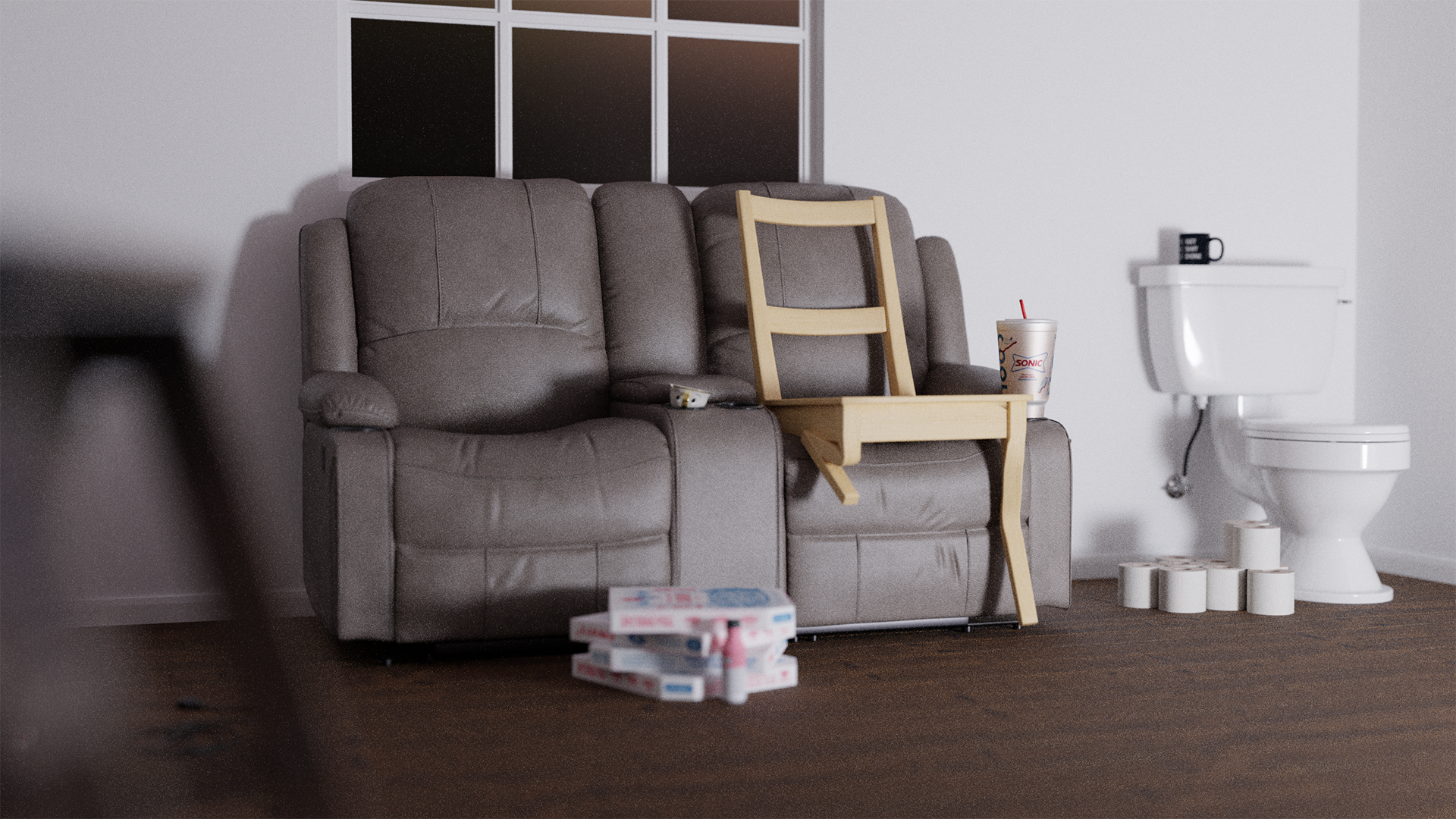
Chair Motion Studies takes inspiration from the Bertil chair, an IKEA product that marked the shift from photography to computer generated imagery (CGI) in the company’s catalogue. Silently introduced in 2006, its synthetic image blended seamlessly with photographs taken with cameras, signalling a quiet yet pivotal transformation. By 2014, 75 per cent of IKEA’s imagery had become CGI. The Bertil chair’s power lies not in spectacle but in its ability to remain unnoticed – exposing the allure of photorealistic mundanity as it is reconfigured below the threshold of the visible. Simone C Niquille imagines a speculative evolution of the virtual chair, trained to move via machine learning processes driving ARTIFICIAL INTELLIGENCE (AI) in commercial contexts. Her computergenerated images echo the motion studies of Lillian and Frank Gilbreth, pioneers of efficiency and standardisation in industrial management who developed a technique for recording a body’s movement through long-exposure photography in the early 1900s. Here, the chair becomes a meditation on technology, labour and the invisible forces shaping both virtual and physical production.
related writing
- Hiding in Plain sight: a conversation with Natalie Kane. [permanent beta] Fotomuseum Winterthur (2025) & Spector Books (2025)
- On flatpack furniture and .zip folders, Canadian Center for Architecture (2021)
- "Boring Images" in Soft Photography. ed. Claus Gunti. ECAL/University of Art and Design Lausanne (2026)

↑ Chair Motion Studies. Installation view at Fotomuseum Winterthur, The Lure of the image (2025) Photo Conradin Frei.

↑ Chair Motion Studies. Installation view at C/O Berlin, The Lure of the image (2026) Photo David von Becker.
credits
- Scenography & Camera: Simone C Niquille
- Creative Technologist: Cailean Finn
- Printing: Foto-Labor St. Gallen
Hiding in Plain Sight
A conversation with Natalie Kane on synthetic images and deliberate mundanity
The 2006 IKEA product catalog was a remarkable publication. Yet, it does not read that way – by design. Spread across page 198 and 199 are a selection of chairs and tables laid out on a grid. Top row, third from left, is an image of a chair. The caption reads ‘Bertil chair DKK 295: transparent lacquer, solid birch B39xD49, H87cm. Sits 45cm. Design: Nike Karlsson. 200.877.47’. The image resembles a product photograph, but it isn’t. A real treachery by image, this is the first time IKEA publishes a synthetic image, one that isn’t captured by a photographic camera. The Bertil image very silently screams: 'Nothing to see here, move along.' It successfully goes unnoticed and sets off a shift within IKEA from product photography to 3d rendered imagery. Already a couple years later in 2014, 75% of images in the catalog are synthetic. In this conversation with Natalie Kane, Curator of Digital Design at the V&A museum, we delve into the cultural and technological implications of the 2006 Bertil image and the interplay between product images, computer vision training datasets, societal norms and bodily standards, augmented through life among synthetic images.
"(...) Bertil’s image really is a Murphy’s door to the entangled correlations responsible for contemporary image technology’s power. We must question it. Nothing is as it seems. Don’t assume." scn
related projects


technoflesh Studio ( ᐛ )و
Design & Research practice
of Simone C Niquille
Based in Amsterdam, NL
CONTACT
studio at technofle.sh
INSTAGRAM
@technoflesh